Devin AI: Inside the First Autonomous Software Engineer
How Cognition's Devin works under the hood: the agent loop, its tools, real SWE-bench results, and what it's like to run it as my daily driver.
While writing this post, I had Devin do some renumbering work on other blog posts and rewrite underlying scripts.
This is me sharing a tool I rely on, and why I think you should give it a try too. In March 2024, Cognition introduced Devin, the first autonomous AI software engineer. We're not talking of a smarter autocomplete, nor a mere chat. Devin sets up the environment, writes the code, runs it, debugs its own mistakes, and comes back with a pull request with demo.
What Devin actually is
Devin is a fully autonomous software engineer that runs in its own sandboxed compute environment. You assign work the way you'd assign it to a teammate: a Linear/Jira ticket, a GitHub issue, a Slack message, or a plain prompt. Devin plans and executes the task end to end, reporting progress in real time and accepting feedback along the way.
The deliverable isn't a suggestion in your editor. It's a finished artifact: commits, a branch, a pull request, sometimes a deployed preview.
The part that rewired how I work: sessions are asynchronous and parallel. I can have several Devins working on different tasks while I do something else. My unit of work stopped being "keystrokes I type" and became "tasks I delegate."
How it works under the hood
Cognition describes three pillars behind Devin:
1. Long-horizon reasoning and planning
Devin breaks a task into a plan and executes it over hundreds of steps. It keeps context over time, notices when it went down the wrong path, and backs up to try a different approach. I've watched it abandon a whole refactor direction mid-session because its own tests said so. A static "generate code" prompt can't do that; the agent loop (plan, act, observe, revise) can.
2. A real developer's toolbox
Inside its sandbox, Devin gets the same primitives a human engineer has:
- A shell: install dependencies, run builds, execute tests, reproduce bugs
- A code editor: read and edit files across the whole repo
- A browser: read docs, GitHub issues, your staging deployment
That last one matters more than people realize: most real-world knowledge isn't in the repo. Reading the docs of a library it's never seen is what lets Devin work with unfamiliar technology instead of hallucinating an API.
3. Active collaboration
Devin streams its plan and progress, asks when a decision is truly ambiguous, and takes course corrections mid-task. You're a reviewer and a director, not a babysitter, but you're still in the loop.
What a task looks like end to end
A typical Devin session on a bug report goes roughly like this:
- Context gathering: reads the issue, explores the repo structure, finds the relevant modules
- Environment setup: installs deps, figures out how the project builds and tests run
- Reproduction: writes a failing script or test that demonstrates the bug before touching anything
- The fix: edits the code, iterates against the repro
- Verification: runs the test suite, checks for regressions
- Delivery: opens a PR describing what changed and why
One of Cognition's launch demos still captures the "learns unfamiliar tech" piece best: after reading a blog post, Devin figured out how to run ControlNet on Modal and produced images with concealed messages, like this Statue of Liberty hiding ASCII art in the shading:

Read the docs, set it up, make it work: it's the same loop I run when I pick up a new tool. It just runs it without me.
Performance: what SWE-bench showed
On SWE-bench, the benchmark that asks models to resolve real GitHub issues from projects like Django and scikit-learn, Devin's launch results were the first convincing evidence that end-to-end agents could work:
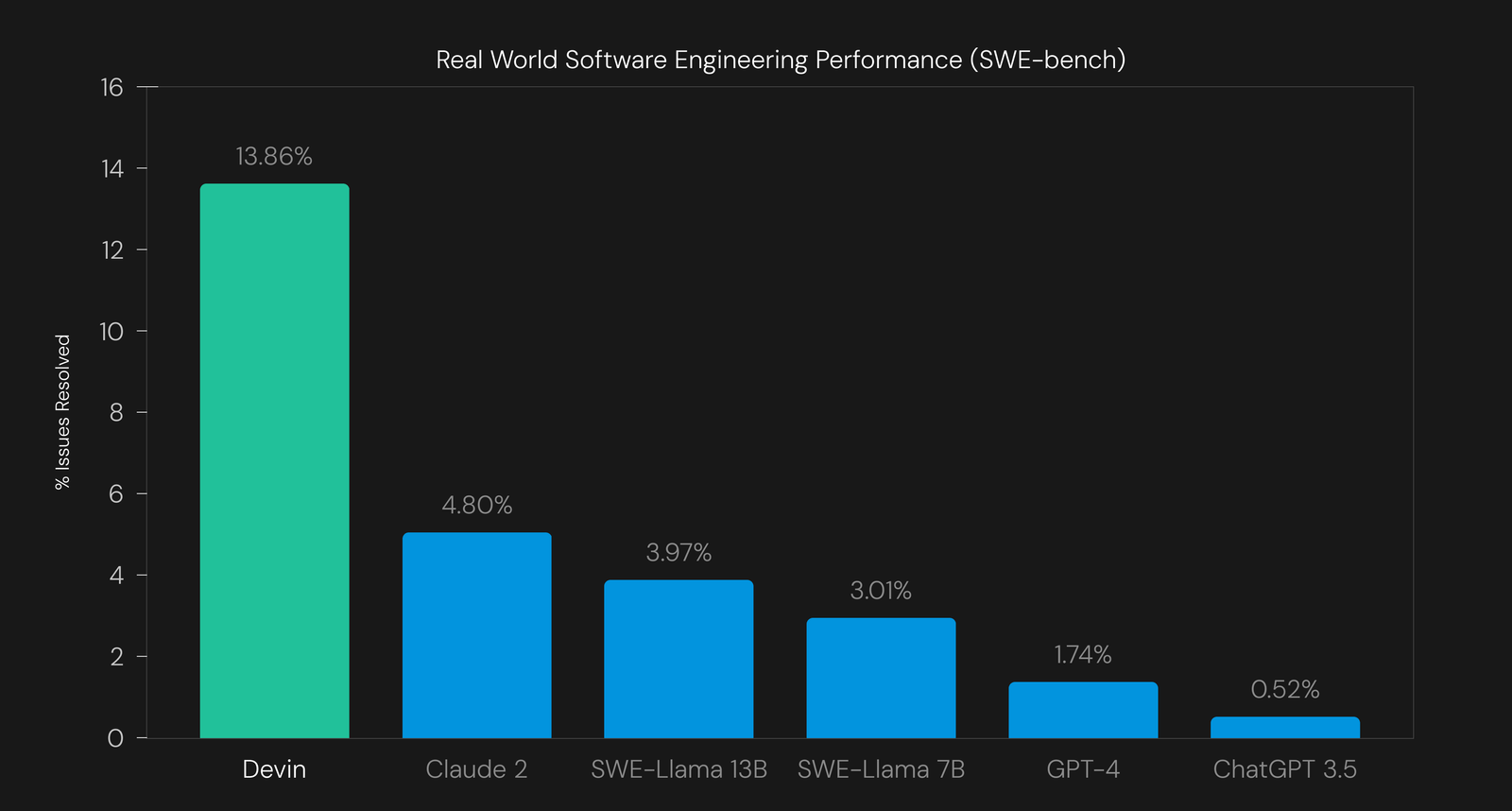
13.86% sounds modest until you remember the baseline was ~2%, and that every other model on the chart needed to be told which files to edit. The leaderboard lives in a different world now, but this was the chart that made me take agents seriously in the first place.
Devin vs Copilot vs Cursor vs Claude Code
People lump these together, but having used them all, they sit at different points on the autonomy spectrum:
| I drive | It drives | Artifact | |
|---|---|---|---|
| GitHub Copilot | Inline suggestions while I type | nothing | Lines of code |
| Cursor / Windsurf | I steer an agentic IDE session | partially | A working tree I finish |
| Claude Code | I supervise a terminal agent | partially | Commits I review live |
| Devin | I assign and review | fully | A PR, while I did something else |
Assistants make me faster. Devin removes me from the critical path entirely, which makes it a different product, not a better autocomplete.
Limitations, from someone who hits them
Where it still falls short:
- Specification quality is everything. Vague task → wrong direction → burned compute. I get the best results on well-scoped work: reproducible bugs, contained features, migrations, like the blog tooling refactor I mentioned.
- Brownfield is hard. Huge monorepos, flaky test suites, and "tribal knowledge" setups still trip it up, same as a new hire, except it can't tap me on the shoulder at the right moment.
- Review is non-negotiable. I treat its PRs like a junior teammate's: usually solid, occasionally confidently wrong.
- Pricing is usage-based. Devin bills in ACUs (Agent Compute Units), roughly a few dollars per ACU on the pay-as-you-go plan at the time of writing, so my sloppy task description has a literal dollar cost. I've learned to write tickets like I mean it.
Where this is heading

Since launch the trend line is clear: Devin Desktop (where I'm running it right now), Devin in Windsurf after Cognition acquired Windsurf, custom models like SWE-1.x, and many Devins in parallel. My job is visibly shifting from writing code to specifying, reviewing, and directing: managing a small fleet of agents rather than a single editor.
The interesting question isn't whether agents write code; mine does. It's how we reorganize around delegation: tickets written for agents, CI designed for agent output, review habits tuned for machine-generated PRs.
Closing thoughts
Devin's real contribution wasn't a benchmark score; it was proving the category. Agent loop + real toolbox + async delegation is a different way to produce software, and everything since (Claude Code, GitHub's agent mode, and friends) is a variation on that theme.
I use it because it changes what my day looks like, not because it's impressive in a demo. And the meta note is still my favorite part: the post-management tooling this article was drafted through was refactored by Devin itself, running as the interactive CLI agent on this blog's codebase, while I wrote this. Daily driver, indeed.